Loss row
Global incident in coll. plane
The change in sunlight from the horizontal to the module plane
Unit kWh/m²
What this step does
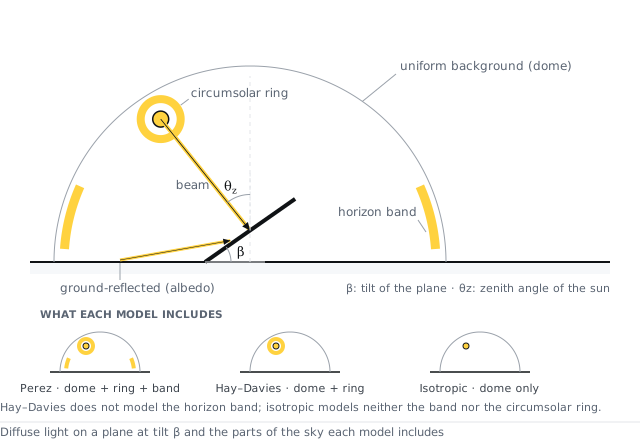
The row measures the change in sunlight from the horizontal surface to the tilted module plane. A plane tilted toward the sun receives more direct sunlight than a horizontal surface, slightly less sky light, and a little light reflected from the ground in front of it. The row is the plane irradiation less the horizontal irradiation. The Model tab's Transposition step sets the sky model that gives the light on the plane.
The math
- Running total
- Gain at a timestep
where
| Symbol | Meaning | Unit |
|---|---|---|
| the running total of the loss diagram before this row | kWh/m² | |
| the running total after this row | kWh/m² | |
| the row, a gain | kWh/m² | |
| the length of one timestep | hours | |
| the irradiance gained at timestep | W/m² | |
| the direct sunlight on the plane | W/m² | |
| the sky diffuse light on the plane | W/m² | |
| the circumsolar part of the diffuse light on the plane | W/m² | |
| the ground-reflected light on the plane | W/m² | |
| the global horizontal irradiance of timestep | W/m² |
Reading the number
A gain, positive, for a plane tilted toward the equator. A low-tilt east-west plane can show a small loss. A 35° plane facing the equator at a mid-latitude site gains about 10 to 15 % over the horizontal irradiation. Single-axis trackers gain more, and low-tilt rooftop arrays gain less.
References
- Perez, Ineichen, Seals, Michalsky & Stewart 1990, Modeling daylight availability and irradiance components from direct and global irradiance, Solar Energy 44(5) 271–289
API
loss.transposition
Symbols follow the symbol registry.