API field
Dispatch
The rule that decides when the battery charges and discharges
What it is
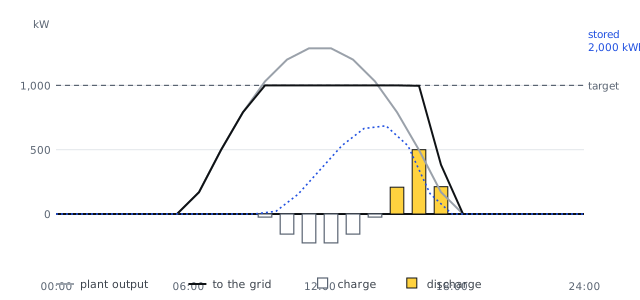
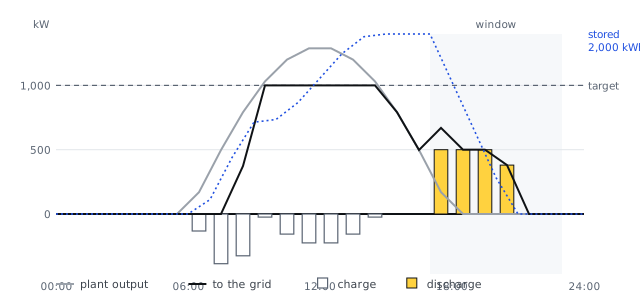
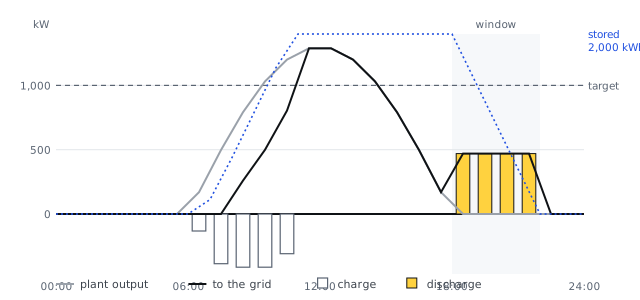
The rule that decides, at every timestep, whether the battery charges, discharges or stays idle. A timestep never does both. The figures show one clear day of a plant whose output peaks at 1,300 kW against a 1,000 kW target, with a 500 kW, 2,000 kWh battery.
Clip capture. The battery charges only from the output above the target (AC coupling) or above the inverters' capability (DC coupling). It delivers that energy in the discharge window, or in any hour when Discharge any hour is on, whenever the plant's output is below the target.
Daily full cycle. Outside the window the battery charges, first from the output above the target and then from output that would otherwise go to the grid, leaving room for the surplus still expected within the look-ahead. Inside the window it discharges down to the target, so it empties every day.
Timed discharge. The battery charges from any output outside the window and delivers a flat power inside it, fixed at the window's first hour so the stored energy lasts to the window's end.
Typical values and how to get it
Clip capture for a system whose output is limited, by its interconnection (AC coupling) or by its inverters (DC coupling). Daily full cycle for a battery that shifts energy into an evening window every day. Timed discharge for a contract that pays for a flat delivery in fixed hours. Dispatch against an energy price series is not available.
Values
Clip capture = clip (default): charges only from the surplus, above the interconnect target with AC coupling or above the inverter's capability with DC coupling, and discharges in the scheduled hours · Daily full cycle = force_cycle: discharges in the scheduled hours and refills from any production, leaving room for the surplus expected within the lookahead · Timed discharge = timed: charges from any production outside the discharge window and delivers a flat power inside it, fixed at the window's first hour
How it is applied
where
| Symbol | Meaning | Unit |
|---|---|---|
| the flat power of a timed window | kW | |
| the power rating | kW | |
| the stored energy at the start of the window's first hour (the end of the hour before it) | kWh | |
| the floor of the state-of-charge window times the capacity | kWh | |
| the discharge efficiency | — | |
| the window length | h |
References
- DiOrio, Dobos & Janzou 2015, "Technoeconomic Modeling of Battery Energy Storage in SAM", NREL/TP-6A20-64641
- Denholm, Eichman & Margolis 2017, "Evaluating the Technical and Economic Performance of PV Plus Storage Power Plants", NREL/TP-6A20-68737
API
storage.dispatch
Symbols follow the symbol registry.