Model map
Select a path
The chain of calculation steps from sun position to grid injection, with every method on offer
What it is
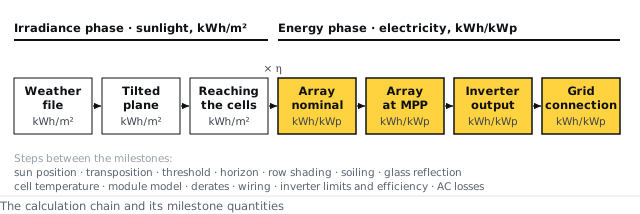
A performance model is a chain of calculations. It starts with the position of the sun, converts the weather file's horizontal sunlight to the tilted module plane, removes what the horizon, the neighbouring rows, the dirt and the glass take away, computes the module temperature and power, and follows the energy through the inverter and the AC equipment to the grid connection. At most of these steps the solar industry has more than one accepted method, published in papers and standards or implemented in tools such as PVsyst, PVWatts, SAM and pvlib.
On this page each row is one step of the chain and each box in a row is one method for that step; the box with the blue border is the method the current run uses. Click a box to switch the run to that method; click its information icon to read what the method does, the equations it uses and where it is published. The steps are in the order the calculation runs, from the irradiance phase to the energy phase.
Reading the boxes
Every box that is not selected has been scored by re-running the current system with that method alone changed. The number in the box is the step's own loss row under that method, in percent, as the loss diagram shows it. The smaller line underneath is the percentage change of the array nominal energy (irradiance phase) or of the energy to grid (energy phase) against the current run. When a step's effect falls on more than one row, or on a row that exists only under some settings, the number in the box is that percentage change instead. A greyed box is a method that cannot run with the current inputs, and it says why. A greyed row is a step that cannot change the result of this run, for example the horizon step when no horizon profile is given.
Presets
The pvperf path button selects pvperf's own path, a published method at every step. On the irradiance side it uses NREL SPA for the sun position, Perez with the published coefficients, the circumsolar light as diffuse and no low-light threshold. A horizon profile gates the beam hour by hour. Row-to-row shading uses Appelbaum's closed form, or the direct projection when the request has a scene. The sky masking uses the view factor. The IAM is the module's own curve when it has one and the Fresnel curve with an anti-reflective coating otherwise; the diffuse and albedo IAM use the effective angles. A bifacial module takes the infinite-sheds view factors. On the energy side it uses the Faiman cell temperature, the Mermoud one-diode model, no spectral correction and no Townsend snow model. The electrical shading follows the strings. The inverter efficiency blends the OND file's three curves by voltage. The DC wiring drop uses the operating current, and the AC resistive losses are computed on the power each stage carries. Every AC component is modelled. The power factor has its own loss row. The PVsyst 8 path, PVWatts path and SAM path buttons select, at every step, the method of PVsyst 8, of PVWatts version 8 or of SAM's detailed photovoltaic model. The SAM path uses the module's own CEC parameters when the module comes from the CEC library, and the representative module of the PVWatts path otherwise. A button is filled when every live step of the current run uses that preset's method. When only sub-choices differ, the button has a blue border and shows the number of overrides.