Reference / Where the correction acts
Model option
After the cell temperature
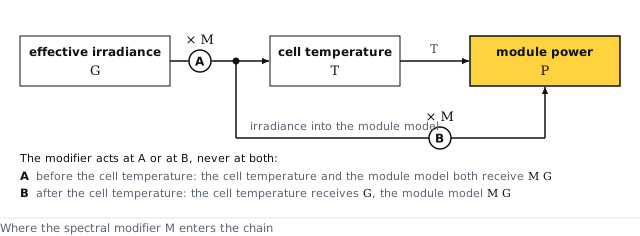
The correction on the module model's irradiance, the cell temperature from the uncorrected irradiance
Inputs used: Spectral application, Spectral air mass, Air-mass cap, Station pressure, Altitude
Method
The cell temperature is computed from the irradiance before the correction. The module's maximum power is then evaluated at the corrected irradiance and that cell temperature, point B of Figure 10. The electrical shading and the flat derates act on this corrected power. In the loss diagram the irradiance-level and temperature rows are measured at , and the spectral row is the module power at minus the module power at , both at the same cell temperature. The air mass is the Kasten 1966 relative air mass times an altitude factor that falls with the site elevation, floored at 0.58, with no cap unless the Physics tab sets one.
Settings
| Setting | Value |
|---|---|
| Relative air mass | Kasten 1966 |
| Altitude factor | , with the site elevation in m |
| Air-mass cap | none; the air-mass cap on the Physics tab when it is set |
| Irradiance the cell temperature is computed from | , before the correction |
| Power the spectral row is measured on | , the module's maximum power at the cell temperature |
The math
- Air mass
- Spectral modifier
- Module power
- Spectral row
where
| Symbol | Meaning | Unit |
|---|---|---|
| the air mass: the path length of the sunlight through the atmosphere relative to a vertical path at sea level | — | |
| the altitude factor of the air mass | — | |
| the relative air mass of Kasten 1966 | — | |
| the air-mass cap on the Physics tab; without a cap this limit is absent | — | |
| the site elevation | m | |
| the elevation of the sun above the horizon | degrees | |
| the spectral modifier of the timestep, a factor near 1 | — | |
| the six coefficients of the module's cell technology | — | |
| the precipitable water, held between 0.1 and 8 cm | cm | |
| the array power at its maximum-power point, before the electrical shading and the flat derates | W | |
| the number of modules | — | |
| the maximum power of one module at irradiance and cell temperature | W | |
| the effective irradiance on the modules before the correction, with the rear side's share on a bifacial array | W/m² | |
| the cell temperature | °C | |
| the cell-temperature model of the Cell temperature step, as a function of the front irradiance | °C | |
| the front irradiance the cell temperature is computed from, before the correction | W/m² | |
| the power the spectral correction removes at the timestep, the spectral row of the loss diagram; negative when exceeds 1 | W | |
| the module power the spectral row is measured on, at irradiance | W |
References
- Lee & Panchula 2016, Spectral correction for photovoltaic module performance based on air mass and precipitable water, IEEE 43rd Photovoltaic Specialists Conference
- Kasten 1966, A new table and approximation formula for the relative optical air mass, Archiv für Meteorologie, Geophysik und Bioklimatologie B14 206–223
- PVsyst 8 help, Spectral correction
- Analysis of PVsyst 8.1.5 outputs shows this convention in its results.
API
spectral.application = power_ratio, spectral.airmass_method = kasten_1966
Symbols follow the symbol registry.