Model option
Marion › Published
The view-factor model of Marion et al. in 1° sectors, as NREL's bifacialvf code runs it
Inputs used: Bifaciality factor, Height above ground, Transparent fraction of the module plane, Structure shading factor, Ground albedo (bifacial system), Albedo, Number of rows
Method
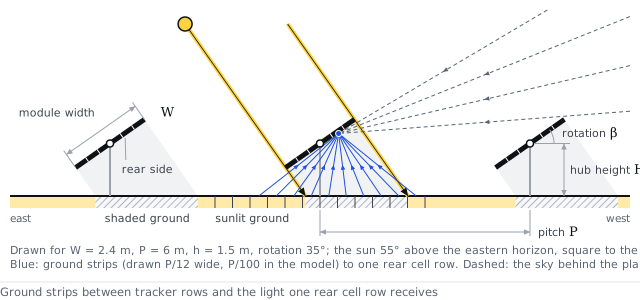
The model, its geometry and its equations are those of the bifacialvf option above, with three differences from SAM's coding. The rear cell rows' view of the next row is projected onto that row in units of its slope length, so the next row's six cell rows each span a sixth of its width. The horizon band is normalised by ½(cos 84° − cos 90°) on the front as on the rear. A tracker facing west returns its cell rows from the top, as bifacialvf orders them. The cell rows' irradiance is otherwise unchanged by the order.
References
- Marion et al. 2017, A practical irradiance model for bifacial PV modules, NREL/CP-5J00-67847
- NREL bifacialvf, Bifacial PV view factor model for system performance calculation, source code and documentation (github.com/NREL/bifacialvf, bifacialvf.readthedocs.io)
API
bifacial.model = bifacialvf_published