Model step
Rear side and front ground reflection
Rear-side irradiance and ground-reflected irradiance on the front
Inputs used: Bifaciality factor, Height above ground, Transparent fraction of the module plane, Structure shading factor, Ground albedo (bifacial system), Albedo
What it is
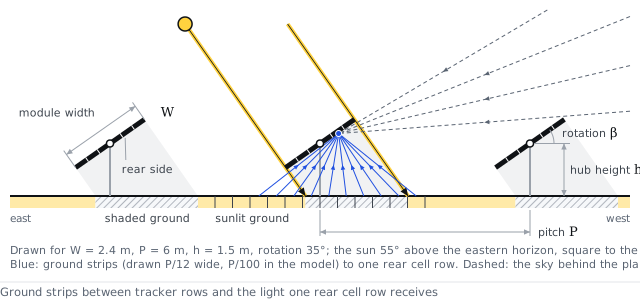
A bifacial module also converts the light that reaches its rear side: light reflected from the ground between the rows, sky light from behind, and direct sunlight when the sun is behind the plane. The step computes the irradiance on the rear side. The option Unlimited sheds or trackers 2D also computes the ground-reflected light that reaches the front side of each row. The step does nothing for a monofacial module. With a 3D scene, each orientation group gets its own rear-side calculation from the group's orientation and the racking section's height, ground cover ratio and widths, and the groups' results are combined weighted by their module counts. The scene's objects do not shade the rear side.
Options
- Unlimited sheds or trackers 2D (PVsyst): two-dimensional view factors between rows of unlimited length and the ground, for fixed rows and for trackers on a level axis
- bifacialvf (Marion 2017): NREL's view-factor model with ground strips and cell rows
- bifacialvf 1° sectors (Marion 2017): Marion's bifacialvf model: six rear cell rows whose field of view is cut into 1° sectors on the sky, the next row and the ground
- Infinite sheds (Mikofski 2019): Mikofski's infinite sheds: the rear face's view of the sky and of the lit and shaded ground
- Monofacial: no rear side
References
- Marion et al. 2017, A practical irradiance model for bifacial PV modules, NREL/CP-5J00-67847
API
bifacial.model = sheds_2d | view_factor | infinite_sheds | bifacialvf, or bifacial = null