Reference / Rear side and front ground reflection
Model option
bifacialvf (Marion 2017)
NREL's view-factor model with ground strips and cell rows
Inputs used: Bifaciality factor, Height above ground, Transparent fraction of the module plane, Structure shading factor, Ground albedo (bifacial system), Albedo
Method
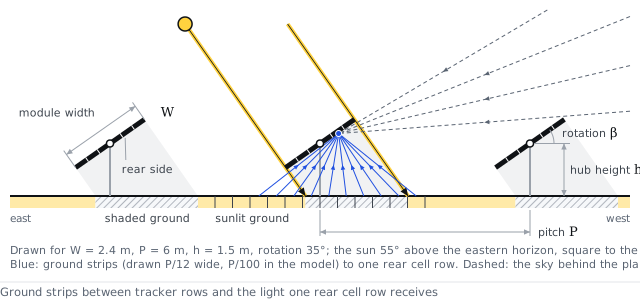
The figure shows the section across three tracker rows in the morning. The rows are taken as unlimited in length, so the model works in this plane. Each row is a flat slab whose width, the module width of the figure, is the collector width. The slab is centred on an axis at the hub height of the figure. On a tracker is the height above ground of the System tab, measured at the axis. On a fixed row that height is the lower edge, so is the height above ground plus half the collector width times the sine of the tilt. The rows stand one pitch apart. A tracker row turns to the rotation of the timestep, and a fixed row keeps its tilt.
The ground of one pitch, centred under a row, is cut into 100 strips. The whole diffuse horizontal irradiance counts as a uniform sky. A strip receives the part of that sky it sees past the rows, its sky view factor (1). The factor leaves out the directions hidden by the row above the strip and by three rows on either side, and weights each open direction by the cosine of its angle from the vertical. The sun rays in the figure graze the slab edges and mark where the shadow ends on the ground. A strip whose centre lies in the sunlit ground also receives the direct sunlight on the horizontal, (2). A strip in the shadow receives no direct sunlight. The transparent fraction of the module plane is not used by this option.
The rear side is cut into six cell rows. Each cell row sees each strip through a two-dimensional view factor (3), which depends on the distance between them and on the angle of the line joining them at each end. A strip counts zero when it lies on the front side of the module plane or when the neighbouring row on either side hides it. The blue fan in the figure draws these lines for one cell row. The ground reflects the albedo fraction of its light evenly in every direction. A cell row therefore receives from each strip the view factor times the albedo times the strip's irradiance, less the part the glass reflects at that angle. The rear irradiance (4) is the average of this ground light over the six cell rows plus the sky light behind the plane, taken from a uniform sky with no row in the way (the dashed lines). When the sun is behind the plane, its direct light on the rear side counts as well. The structure shades a fixed fraction of the rear side.
The module converts the front irradiance plus the rear irradiance scaled by the bifaciality factor (5). The ground-reflected light on the front side is the albedo term of the transposition step, and this model adds nothing to it. The view factors depend only on the rotation, so they are computed once per whole degree of rotation and reused through the year.
Settings
| Setting | Value |
|---|---|
| Ground strips across one pitch | 100 |
| Cell rows on the rear side | 6 |
| Rows that hide the sky of a strip | the row above it and 3 on each side |
| Rotation step of the view-factor table | 1° |
The math
- The sky each ground strip sees
- The light on each ground strip
- The view factor from a cell row to a strip
- The light on the rear side
- The light the module converts
where
| Symbol | Meaning | Unit |
|---|---|---|
| the sky view factor of ground strip : the share of a uniform sky it sees past the rows | — | |
| the rows that hide part of the sky: the row above the strip and three rows on either side | — | |
| the angles from the vertical, at the centre of strip , to the two edges of row , the smaller one first, with the ranges of overlapping rows merged | degrees | |
| the irradiance on ground strip | W/m² | |
| the diffuse horizontal irradiance of the weather file | W/m² | |
| the global horizontal irradiance | W/m² | |
| the view factor from cell row of the rear side to ground strip | — | |
| the angle between the line from cell row to the centre of strip and the perpendicular to the rear side | degrees | |
| the angle between the same line and the vertical | degrees | |
| the distance from cell row to the centre of strip | m | |
| the width of one strip | m | |
| the row pitch, the distance between the rows | m | |
| the irradiance on the rear side | W/m² | |
| the fraction of the rear side shaded by the structure | — | |
| the ground albedo: the bifacial albedo when it is set, otherwise the site's albedo of the month | — | |
| the transmission of plain glass (refractive index 1.526) at the angle in brackets, relative to its transmission at normal incidence | — | |
| the tilt of the module plane from the horizontal, the rotation angle for a tracker on a horizontal axis | degrees | |
| the direct normal irradiance | W/m² | |
| the angle between the sun and the perpendicular to the module plane | degrees | |
| the irradiance the module model converts | W/m² | |
| the effective irradiance on the front side after the shading, soiling and glass-reflection steps | W/m² | |
| the bifaciality factor of the module: its rear-side efficiency relative to the front | — |
References
- Marion et al. 2017, A practical irradiance model for bifacial PV modules, NREL/CP-5J00-67847
- NREL bifacialvf, Bifacial PV view factor model for system performance calculation, source code and documentation (github.com/NREL/bifacialvf, bifacialvf.readthedocs.io)
API
bifacial.model = view_factor
Symbols follow the symbol registry.