Reference / Rear side and front ground reflection
Model option
Infinite sheds (Mikofski 2019)
Mikofski's infinite sheds: the rear face's view of the sky and of the lit and shaded ground
Inputs used: Bifaciality factor, Height above ground, Transparent fraction of the module plane, Structure shading factor, Ground albedo (bifacial system), Albedo
Method
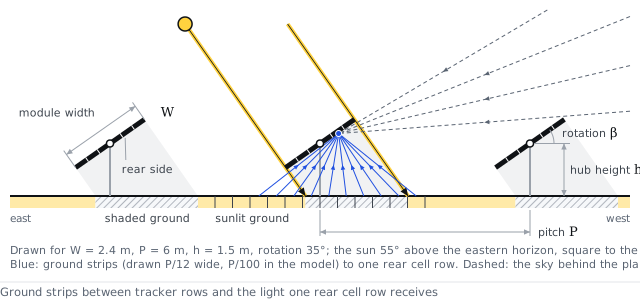
The rows are of unlimited length on level ground, and the model works in the vertical section across them. At each timestep the rows' shadows split the ground between two rows into a lit part and a shaded part (1). The ground receives the beam on its lit part and the sky diffuse through its own view of the sky between the rows, integrated across the pitch with the rows within 5° of the horizon as obstructions, and reflects the albedo share of it (2). The rear face, the face at 180° minus the tilt that looks away from the front, sees the sky past the rows (3) and the ground between the rows (4), each through a view factor averaged over the collector width by Hottel's crossed strings. When the sun is behind the front face, the rear face receives the beam on the part the row toward the sun leaves lit (5). The rear irradiance is the sum (6). The sky is isotropic, and no incidence-angle loss is applied on the rear, as the model is published. The structure shade factor of the bifacial section then takes its share, and the rear mismatch loss acts in the energy stage. The front side keeps the transposition's ground term and the near-shading step's mask, as the view-factor option does. Values the model derives from other inputs: the pitch is the collector width over the ground cover ratio; the height of the row centre is the height above ground plus half the collector width times the sine of the tilt on a fixed rack, where the height above ground is the bottom edge, and the height above ground itself on a tracker, where it is the axis. Each timestep uses the plane's own tilt and azimuth; a tracker on a tilted axis is treated in the model's level-axis section. The bifacial section's transmission factor is not used.
The math
- Lit fraction of the ground
- Ground irradiance
- Rear face's view of the sky
- Rear face's view of the ground
- Shaded part of a face
- Rear irradiance
where
| Symbol | Meaning | Unit |
|---|---|---|
| the fraction of the ground between two rows the beam reaches; 0 when the projected sun is more than 85° from the zenith | — | |
| the ground positions of the shadows of the two edges of row | m | |
| the row pitch, the distance between the rows | m | |
| the collector width | m | |
| the tilt of the module plane from the horizontal | degrees | |
| the height of the row centre | m | |
| the tangent of the sun's zenith angle projected on the section across the rows, | — | |
| the irradiance the ground reflects, averaged over the pitch | W/m² | |
| the ground albedo of the month, a fraction | — | |
| the global horizontal irradiance | W/m² | |
| the diffuse horizontal irradiance of the weather file | W/m² | |
| the ground's view factor to the sky, averaged over the pitch by crossed strings with the rows as obstructions | — | |
| the rear face's view factor to the sky, averaged over the collector width | — | |
| the tilt of the rear face, 180° minus the tilt | — | |
| the ground cover ratio, the collector width over the pitch | — | |
| the rear face's view factor to the ground between the rows, averaged over the collector width | — | |
| the crossed-string length from the face's lower edge to the start of ground interval , bent round the neighbouring row's edge when that row hides the straight string; likewise, the upper edge and the end of the interval | — | |
| the fraction of the face, from its bottom, that the row toward the sun shades | — | |
| the tilt of the face | — | |
| the projected sun tangent in the face's own azimuth | — | |
| the angle of incidence of the beam on the face | — | |
| the irradiance on the rear face before the structure shade factor | W/m² | |
| the direct normal irradiance | W/m² | |
| the angle of incidence of the beam on the rear face | — |
References
- Mikofski, Darawali, Hamer, Neubert & Newmiller 2019, Bifacial Performance Modeling in Large Arrays, IEEE 46th Photovoltaic Specialists Conference, 1282–1287
- Marion et al. 2017, A practical irradiance model for bifacial PV modules, NREL/CP-5J00-67847
- pvlib-python 0.16.1 source code (github.com/pvlib/pvlib-python), reference implementation: pvlib/bifacial/infinite_sheds.py, get_irradiance(); pvlib/bifacial/utils.py, the view factors
API
bifacial.model = infinite_sheds
Symbols follow the symbol registry.