Model step
Transposition
Horizontal irradiance to plane-of-array irradiance
Inputs used: Plane tilt, Azimuth, Global horizontal irradiance, Diffuse horizontal irradiance, Direct normal irradiance, Albedo
What it is
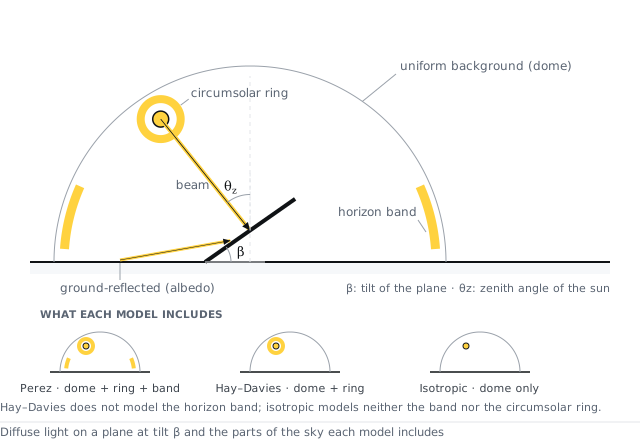
The weather file gives the sunlight on a horizontal surface and the direct beam, and the modules are tilted. The transposition converts the horizontal values into the light on the tilted plane. The direct sunlight converts by geometry alone. The diffuse sky light needs a model of how bright each part of the sky is, and that is where the methods differ. The ground-reflected light follows from the albedo and the tilt.
Options
- Perez 1990: a sky of a uniform dome, a circumsolar ring and a horizon band
- Hay–Davies: a bright ring around the sun weighted by the clearness of the sky, uniform elsewhere
- Isotropic: a uniform sky
References
- Perez, Ineichen, Seals, Michalsky & Stewart 1990, Modeling daylight availability and irradiance components from direct and global irradiance, Solar Energy 44(5) 271–289
- Hay & Davies 1980, Calculation of the solar radiation incident on an inclined surface, Proceedings of the First Canadian Solar Radiation Data Workshop, 59–72
- Liu & Jordan 1963, The long-term average performance of flat-plate solar-energy collectors, Solar Energy 7(2) 53–74
API
array.transposition_model = perez | hay_davies | isotropic