Model option
Perez 1990
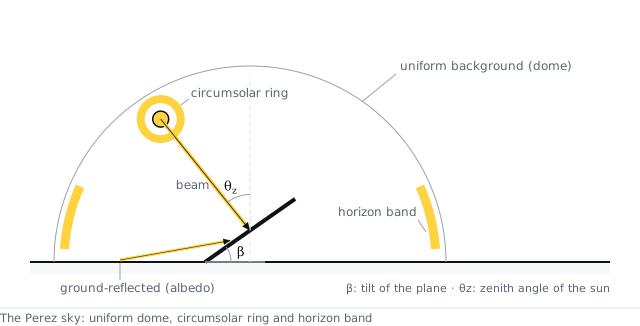
A sky of a uniform dome, a circumsolar ring and a horizon band
Inputs used: Plane tilt, Azimuth, Global horizontal irradiance, Diffuse horizontal irradiance, Direct normal irradiance, Albedo
Method
The Perez model splits the diffuse sky light into three parts: a uniform dome, a bright ring around the sun (the circumsolar region) and a bright band along the horizon. The circumsolar coefficient moves a share of the diffuse light from the dome to the ring, and the horizon-band coefficient sets the strength of the band. Both coefficients come from a published table: the sky clearness selects the row, and within the row they vary with the sky brightness and the zenith angle of the sun. On a clear day most of the diffuse light comes from near the sun; under an overcast sky it comes evenly from the dome. The direct sunlight converts to the plane by the cosine of the incidence angle, and the ground-reflected light by the albedo and the tilt. The Perez settings step fixes the solar constant and its eccentricity factor , the source of the direct normal irradiance, the air-mass formula, the altitude factor and the limits , and .
The math
- Extraterrestrial irradiance
- Direct sunlight
- Sky clearness
- Sky brightness
- Circumsolar and horizon-band coefficients
- Uniform part
- Circumsolar part
- Horizon-band part
- Diffuse sky light on the plane
where
| Symbol | Meaning | Unit |
|---|---|---|
| the extraterrestrial normal irradiance | W/m² | |
| the solar constant, set by the Perez settings | W/m² | |
| the correction for the Earth's distance from the sun at the time of the timestep, set by the Perez settings | — | |
| the direct normal irradiance the model uses, set by the Perez settings | W/m² | |
| the direct sunlight on the module plane | W/m² | |
| the angle between the sun and the perpendicular to the module plane | degrees | |
| the sky clearness, which selects the row of the coefficient table | — | |
| the diffuse horizontal irradiance of the weather file | W/m² | |
| the direct normal irradiance that enters the sky clearness | W/m² | |
| the zenith angle of the sun, 90° minus | radians | |
| the cap on the direct part of the clearness, as a fraction of , set by the Perez settings | — | |
| the sky brightness | — | |
| the relative air mass, from the formula the Perez settings select | — | |
| the altitude factor of the sky brightness, set by the Perez settings | — | |
| the circumsolar coefficient | — | |
| the horizon-band coefficient | — | |
| the six coefficients of the clearness row, from the published table | — | |
| the floor of the circumsolar coefficient, set by the Perez settings | — | |
| the uniform part of the diffuse light on the plane | W/m² | |
| the tilt of the module plane from the horizontal | degrees | |
| the circumsolar part of the diffuse light on the plane | W/m² | |
| the elevation of the sun above the horizon | degrees | |
| the sun elevation below which the circumsolar part is zero, set by the Perez settings | degrees | |
| the horizon-band part of the diffuse light on the plane | W/m² | |
| the diffuse sky light on the module plane | W/m² |
References
- Perez, Ineichen, Seals, Michalsky & Stewart 1990, Modeling daylight availability and irradiance components from direct and global irradiance, Solar Energy 44(5) 271–289
API
array.transposition_model = perez
Symbols follow the symbol registry.