Model step
Near shading (row to row)
Beam shading of a row by neighbouring rows
Inputs used: GCR (ground cover ratio), Collector band width, Plane tilt, Top inactive band, Bottom inactive band, Number of rows, Model row-to-row shading, Backtracking
What it is
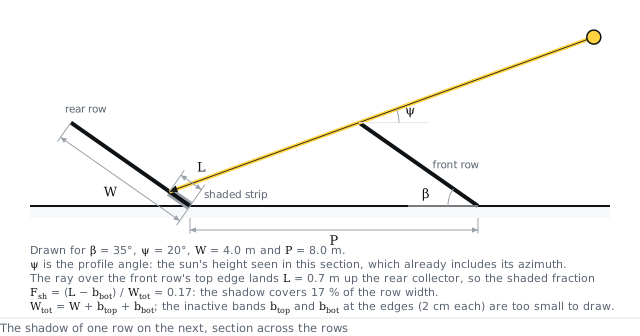
When the sun is low, each row casts a shadow that climbs the row behind it. This step computes the shaded fraction of the module plane at every timestep, from the row geometry or, with a scene, from the projected tables and objects, and the share of sky and ground light the rows hide. The row geometry is the pitch, the collector width, the tilt or tracker rotation, and the inactive bands at the edges. A tracker that backtracks casts no shadow on its neighbour.
Options
- Infinite rows, PVsyst application: the shadow from the profile angle on rows of unlimited length, with inactive edge bands
- Appelbaum geometric closed form: the closed form of Appelbaum and Bany on the bare collector width
- Shading-factor table, PVsyst application: the direct-light factor read from a table indexed by sun position, built by projecting the scene's mounting tables and objects
- Deline linear self-shading: the linear self-shading of Deline and co-workers on rows of unlimited length
- Deline non-linear self-shading: Deline's DC derate from the shaded substrings
- Direct projection: each table's neighbours and the scene's objects projected onto the table at every timestep (Quaschning and Hanitsch 1995)
- Do not model: no row-to-row shading
References
- Appelbaum & Bany 1979, Shadow effect of adjacent solar collectors in large scale systems, Solar Energy 23(6) 497–507
API
array.inter_row_shading = true | false, array.shading_model = unlimited_sheds | geometric | pvsyst_table | deline | deline_nonlinear | direct