Reference / Near shading (row to row)
Model option
Deline non-linear self-shading
Deline's DC derate from the shaded substrings
Inputs used: GCR (ground cover ratio), Collector band width, Plane tilt, Top inactive band, Bottom inactive band, Number of rows, Model row-to-row shading, Backtracking
Method
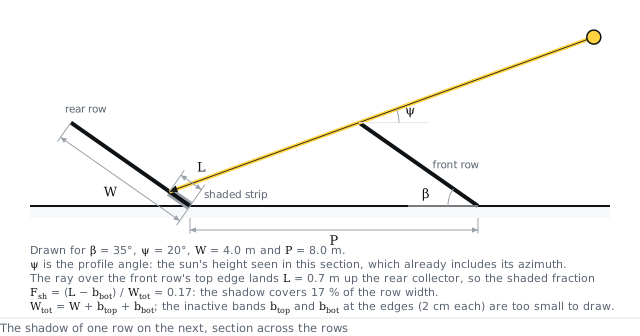
The model of Deline and co-workers for rows of crystalline modules that shade each other uniformly. The sky and ground diffuse are derated as in the linear option. The beam is not reduced on the plane: a shadow on the bottom of a row switches off whole substrings behind their bypass diodes, so its effect is an electrical one. At each timestep the shadow height up the collector is the linear option's shaded fraction times the modules' height up the table, the number of modules up it times their side (the true-tracking shaded fraction on trackers without backtracking, none under backtracking). From it and the layout, X, the fraction of the rows' substrings shaded, and S, the shaded fraction of a substring, follow (1, 2). With the fill factor and the diffuse share of the plane irradiance after the diffuse derates (3), the DC derate is the largest of three bounds, weighted by X (4); the module power is multiplied by it on the electrical shading row.
Values the model fills in or derives. The model's own assumptions: strings wired along the row (horizontal wiring), three bypass diodes per module, one string along a row of modules. Derived from pvperf's inputs: the modules sit in landscape when the collector width is closer to a whole number of module short sides than of long sides, in portrait otherwise; the modules up the table are that whole number; the modules along a row are the modules per string; the rows are the number the Row count step sets; the row spacing is the pitch. The fill factor and the V_mp are the module's standard-condition values.
The math
- Shaded substrings, portrait (horizontal wiring)
- Shaded substrings, landscape (horizontal wiring)
- Fill factor and diffuse share
- DC derate
where
| Symbol | Meaning | Unit |
|---|---|---|
| the fraction of the rows' substrings shaded | — | |
| the shaded fraction of a shaded substring; 1 on trackers | — | |
| the shadow height up the collector | m | |
| the row-end offset of the shadow, , between 0 and the row length | m | |
| the module's long and short sides | m | |
| the modules up the table | — | |
| the modules along a row | — | |
| the number of rows | — | |
| the bypass diodes per module, 3 | — | |
| the module fill factor at standard conditions | — | |
| the diffuse share of the plane irradiance after the diffuse derates | — | |
| the beam on the plane | W/m² | |
| the sky diffuse and the ground-reflected irradiance after the derates, in W/m²; the ground-reflected part is the albedo times times the ground factor, also with the sun less than 2.5° above the horizon | — | |
| the DC derate of the timestep; the module power is multiplied by it | — | |
| the module's maximum-power voltage at standard conditions | V |
References
- Deline, Dobos, Janzou, Meydbray & Donovan 2013, A simplified model of uniform shading in large photovoltaic arrays, Solar Energy 96 274–282
- Gilman, DiOrio, Freeman, Janzou, Dobos & Ryberg 2018, SAM Photovoltaic Model Technical Reference Update, NREL/TP-6A20-67399
API
array.inter_row_shading = true, array.shading_model = deline_nonlinear
Symbols follow the symbol registry.